
Water Wise: How Solar Can Help Irish Farms Retain Water and Build Climate Resilience
By Dawn Keegan & Priscila Mc Geehan
Ireland is known for its rain but increasingly, we’re also seeing drought warnings, dry soils, and heat stress across farmland. As these weather patterns are becoming more frequent and intense, these are the modern-day paradoxes facing farmers, managing water not just in abundance, but in scarcity.
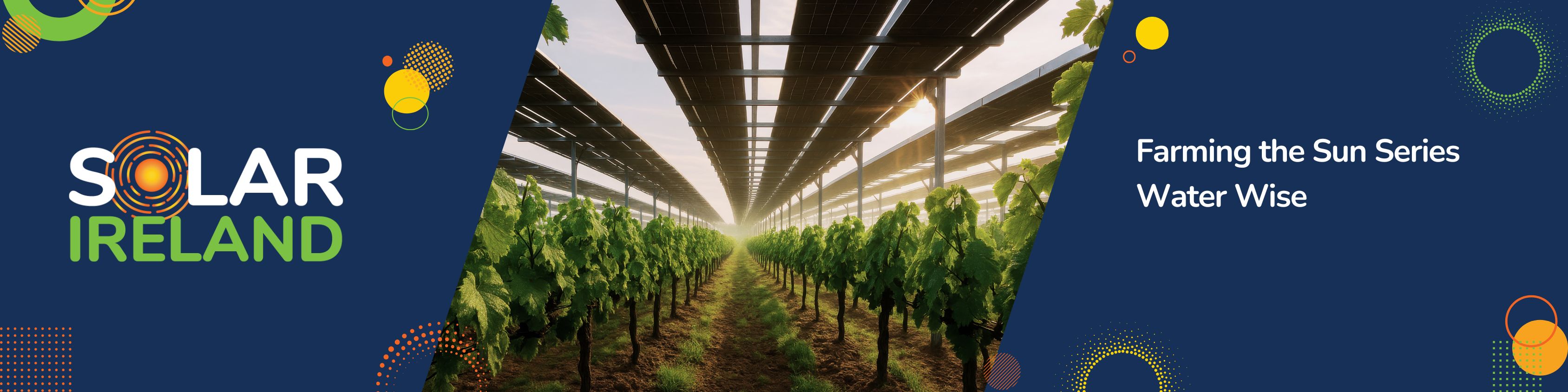
As climate change disrupts traditional weather patterns, farms need new tools to stay productive and resilient. One emerging solution? Agri-PV – solar energy systems designed to co-exist with agriculture and support environmental outcomes, including water management.
This is the second in our Farming the Sun blog series, in collaboration with Power Capital Renewable Energy, exploring how thoughtfully designed solar farms can complement Irish farmland rather than compete with it.
The Water–Solar Connection
At first glance, solar panels and water might seem unrelated. But on farms, shade, soil cover, and runoff management all play a role in protecting water resources, and that’s where solar can help:
- Panel shade reduces evapotranspiration, helping soil retain moisture longer in hot or dry conditions
- Vegetation under panels can slow rainwater runoff and encourage infiltration
- Permeable site design and light-touch construction techniques can protect watercourses and reduce erosion
- Integrated land use can reduce the need for additional irrigation or land clearing
- Reduced chemical use supports more sustainable land management and reduce the likelihood of water pollution through run off
Done right, agri-PV can act like a climate-smart canopy – protecting soils, supporting pastures, and making every drop of water go further.
Why This Matters for Irish Farms
While Ireland may not face the same extreme droughts as Southern Europe, we’re not immune to water-related stress. According to Teagasc and Met Éireann:
- Dry spells and heatwaves are increasing in frequency and intensity
- Spring droughts are affecting grass growth, timing and silage yields
- Livestock are more vulnerable to heat stress and limited drinking water
- Soil degradation can lead to soil compaction, and reduced infiltration, making land less productive and prone to erosion
- Nutrient losses can occur during drought conditions, as crops are unable to effectively absorb fertilisers when soil moisture is too low.
- Water pooling and runoff into neighbouring lands can cause disputes and require mitigation through costly planting or drainage redesign
Solar panels can create microclimates that moderate temperatures and reduce water loss from grasslands and crop soils. For grazing animals, the shade also offers heat relief, improving welfare and productivity.
Agri-PV won’t replace rain, but it can help farms manage water in a more sustainable and economical matter. By creating microclimates, reducing evaporation, and encouraging better water infiltration, solar installations can stretch limited water resources further. In a changing climate where both drought and deluge are becoming more common, this kind of resilience is increasingly vital for Irish agriculture.
Across Europe, farmers are trialling dual-use grazing systems – where sheep graze under and between rows of solar panels. The shade protects the pasture from drying out too quickly, and ground cover reduces dust, erosion, and runoff. It’s simple, low-tech, and effective.
In Ireland, we’re starting to see similar models tested – combining renewable energy generation with improved pasture management and water retention.
We hope to share case studies of these trials soon as part of this series.
Designing Solar for Water Resilience
If Ireland wants to scale agri-PV in a way that genuinely supports farming and biodiversity, site design matters. That means:
- Maintaining natural drainage patterns
- Avoiding soil compaction during construction
- Preserving riparian zones and wetland buffers
- Including ground-level planting to support infiltration and carbon retention
We believe these principles should become standard practice not just in agri-PV, but across the wider solar development landscape.
Government support: Unlocking Agri-PV potential
If Ireland wants to scale agri-PV in a way that genuinely supports farming and biodiversity, site design matters – but so does policy design. Government support can play a pivotal role in making agri-PV financially viable and ecologically responsible.
Here are key mechanisms already in place or under discussion:
- TAMS III (Targeted Agricultural Modernisation Scheme): Offers up to 60% grant aid (capped at €90,000) for solar PV installations on farms, including dairy, beef, tillage, and sheep sectors. Batteries are also eligible for support.
- Young Farmer Capital Investment Scheme: Includes solar PV among eligible technologies, supporting energy efficiency and sustainability in the next generation of farmers.
- Despite the availability of general renewable energy schemes, there are currently no agri-PV-specific incentives in Ireland. While programmes like TAMS III and the Capital Allowance support, they do not yet offer tailored support for integrated land-use systems to promote dual use agri PV. Dedicated incentives, such as targeted grants, tax relief for dual-use installations, or streamlined planning pathways, could help unlock the full potential of solar in Irish agriculture.
What’s Next?
In our next blog, we’ll explore how solar can support soil health – from erosion prevention to regenerative potential.
If any farmers, ecologists, and landowners working with nature in solar projects have any insights or a story to share, we’d love to hear it. Please get in touch via info@solarireland.ie
Let’s build a solar future that protects every drop and every acre.
Read our previous blog here.