
Solar Ireland Statement on Serious Inaccuracies in Recent Reporting on Solar Farms
Solar Ireland is issuing this statement in response to a recent article on solar development in Co. Longford that contains multiple inaccuracies, misleading claims and unsubstantiated allegations. The article does not reflect national data, established industry practice or the detailed information already in the public domain for the project referenced.
Misinformation does not serve communities, farmers or Ireland’s climate and energy goals. It risks undermining public trust, fueling division and misrepresenting what is happening on the ground. Below are the factual corrections.
1. Ireland is not “losing food-producing land” to solar. The claim is false.
Solar Ireland’s analysis shows that reaching Ireland’s indicative 8 GW solar target would require around 0.1% of the country’s land area.
In other words, 99.9% of Ireland remains available for farming, food production, grazing, biodiversity restoration, forestry, tourism and rural enterprise.
On individual solar farms, panels typically cover approximately 40% of each site, with the remaining 60% of the land left as grassland suitable for grazing. This essential context was not reflected in the article.
2. Solar farms do not remove land from agriculture. Agricultural activity continues.
The reporting provides an inaccurate picture of how solar operates on Irish farmland.
Here are the facts:
Solar farms are temporary and fully reversible.
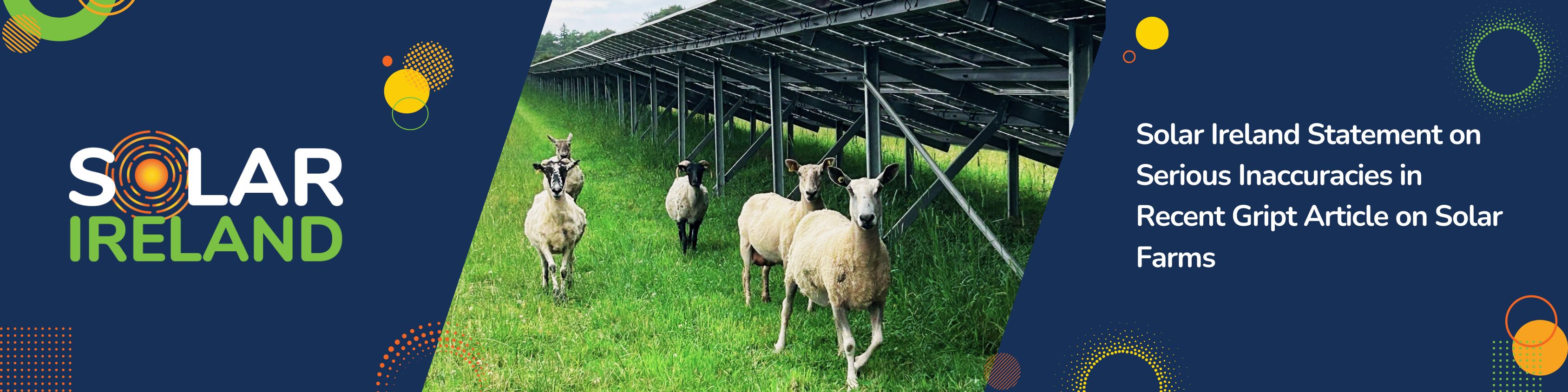
Around 60% of a typical solar farm remains open grassland suitable for grazing.
Sheep grazing continues for the full lifetime of most Irish projects.
Solar does not seal, sterilise or permanently remove land from farming. In reality, solar farms give the land a period of rest. With no tillage or heavy machinery, grass cover is maintained, soil structure improves, organic matter increases and erosion is reduced. Many sites see stronger soil health over time, which enhances the land’s long-term agricultural value.
The IFA has acknowledged that solar can work successfully on grazing land.
None of these realities were acknowledged in the article.
3. Claims of “no consultation” are demonstrably untrue.
The article states that consultation with locals was “virtually zero”. This is factually incorrect.
The developer has already published extensive pre-planning and planning-stage engagement, including leaflet drops, a public information event, elected-representative briefings, a dedicated project website, follow-up communications and ongoing responses to queries.
Solar Ireland does not comment on individual applications, but when detailed engagement records exist in the public domain, they must be reflected accurately in reporting.
4. Claims that solar offers no economic benefit to rural communities are misleading.
Solar development provides real economic value across rural Ireland. Projects support:
fencing and groundworks contractors
civil engineering teams
electricians and technical specialists
ecologists, archaeologists and surveyors
long-term land-management and maintenance roles
Operational projects also generate commercial rates that support county services, and Community Benefit Funds that directly support schools, sports clubs, youth groups and local initiatives.
These well-documented benefits were absent from the article.
5. Ireland faces an energy-security challenge, not a land-use crisis.
Ireland imports most of its energy. Expanding home-grown renewable electricity is essential for stability, affordability and long-term resilience.
Solar contributes to this national security challenge while using a very modest amount of land. Suggesting otherwise misrepresents the scale of Ireland’s renewable-energy needs and solutions.
6. Planning guidance exists and is strengthening.
The article claims there are “no proper planning guidelines” for solar. This is misleading.
Solar Ireland and Fehily Timoney published comprehensive industry planning guidance in 2023, covering siting, biodiversity management, landscape integration, design and community engagement. National planning guidelines are now progressing, informed by this work.
Why accuracy matters
Ireland’s transition to clean, home-grown energy requires informed discussion based on facts, not speculation. Misreporting risks confusing communities, undermining trust and slowing progress that benefits rural Ireland.
Solar Ireland will continue to provide clear, factual information to support farmers, communities and policymakers as we work together to strengthen Ireland’s energy security while maintaining and enhancing rural land use.
Reade our full statement on the growing benefits of solar for farmers and rural communities here.