
Solar can give Irish households greater control over their energy future
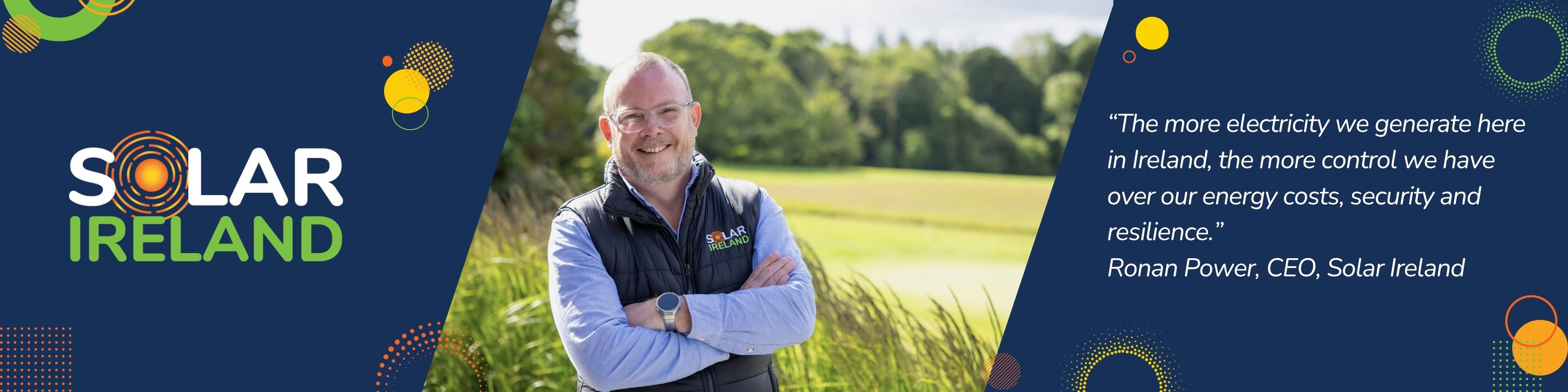
Solar Ireland has welcomed the expansion of Government supports for household solar and battery storage, describing the measures as an important step towards reducing electricity bills and strengthening Ireland’s energy security.
Speaking to Jerry O’Sullivan on Kerry Today, Solar Ireland Chief Executive Ronan Power welcomed the introduction of a new €600 home battery grant, as well as the extension of existing solar PV grants to homes built and occupied before 2025.
The existing solar PV grant provides support of up to €1,800. Together, the solar and battery grants could provide eligible households with up to €2,400 towards the cost of installing a combined system.
“The new battery grant is a very welcome step,” Ronan said. “It will allow more households to store the clean electricity they generate and use it when demand and electricity prices are higher. That gives families more control over their energy costs and reduces their exposure to volatile international energy markets.”
A battery can store surplus electricity generated by rooftop solar panels for use later in the day. It can also store lower-cost electricity purchased during off-peak periods, depending on the household’s electricity tariff.
The Government estimates that a battery could deliver annual savings of up to €137, while a household installing solar PV and battery storage could save up to €878 annually. Actual savings will depend on the property, system size, household consumption and electricity tariff.
Ronan said expanding grant eligibility to newer homes was a positive development, but argued that Ireland should go further by making solar a standard feature of suitable new homes and commercial buildings.
“We should be moving towards a position where solar is treated as part of the fabric of a new building, just like insulation,” he said. “Installing it during construction is generally more straightforward and cost-effective than returning to retrofit the building later.”
More than 120,000 homes have already received support through the SEAI Solar PV grant scheme. The latest package also includes fully funded solar PV and battery systems under the Warmer Homes Scheme, enhanced support of up to €9,000 for eligible households receiving certain social protection payments, and support for qualifying homes in Rental Accommodation Scheme tenancies.
Ronan said the strong demand for rooftop solar showed that people want practical ways to reduce their reliance on the electricity market and take greater control over their long-term energy costs.
“We’re an island off an island off a continent. International energy shocks reach us quickly because Ireland continues to depend heavily on imported fossil fuels. The more electricity we generate here at home, the more energy independence and resilience we create.”
The interview also addressed concerns about the number of renewable energy projects being proposed in North Kerry. Ronan acknowledged that communities are entitled to ask questions about the concentration of development in their area.
“It is important to acknowledge people’s concerns. We all live in communities, and change can be difficult,” he said. “Residents are entitled to ask what a development will mean for their area and to have those questions answered properly.”
He cautioned, however, against treating every proposed project as though it had already been approved or constructed. Projects at the proposal, planning, approved, construction and operational stages are frequently combined when acreage figures are discussed, despite representing very different stages of development.
Not every proposed development will receive planning permission or proceed to construction. Applications must be assessed through the planning process, including consideration of cumulative development, landscape and visual effects, biodiversity, drainage, traffic and proximity to homes.
Ronan explained that the availability of grid capacity also has a significant influence on where projects are proposed. North Kerry has benefited from previous grid reinforcement, making it possible to connect new electricity generation. As planned investment in Ireland’s electricity networks is delivered, more areas should become capable of accommodating renewable projects.
Solar Ireland’s modelling estimates that the ground-mounted solar required to support Ireland’s 8 GW target would use approximately 17,376 acres, equivalent to about 0.1 per cent of Ireland’s total land area.
The full area of a solar development is not covered by panels. Sites include space between panel rows, access routes, setbacks, retained hedgerows, landscaping and areas managed for biodiversity. On suitable developments, agricultural activities such as sheep grazing can also continue.
The local contribution of solar extends beyond electricity generation. Projects supported through the Renewable Electricity Support Scheme contribute at least €2 for every megawatt hour generated to a Community Benefit Fund. Solar developments also pay commercial rates that support local authority services and infrastructure.
Ronan said Solar Ireland was open to discussing how these benefits could be strengthened and made more visible within host communities.
“Community Benefit Funds can support household energy upgrades, sports clubs, community buildings, parks, playgrounds and other local priorities. The important thing is that communities are directly involved in deciding how that money is used.”
Ireland recently passed 3 GW of installed solar capacity. At peak on 27 August, utility-scale solar provided more than one-third of national electricity demand. Ronan said Ireland would need a combination of rooftop solar, appropriately located solar farms, battery storage and continued investment in the electricity grid to build a more secure and affordable energy system.
“This is electricity generated here in Ireland, for Irish homes and businesses,” he said. “Every additional unit of clean power we produce at home reduces our exposure to imported fossil fuels and strengthens our energy resilience.”
The enhanced household grants are due to open from 6 October 2026, subject to final implementation arrangements. Eligibility criteria and full terms and conditions will be available through the Sustainable Energy Authority of Ireland.
Listen to Ronan Power’s full interview on Kerry Today.