
Scaling solar in Ireland: delivery challenges, not land constraints
Recent coverage of solar development in Cork has highlighted the delivery pressures that emerge as Ireland’s solar sector scales, particularly around grid capacity and planning timelines. These challenges are not unique to Cork. They reflect a national system adapting to the pace of renewable deployment now under way.
Concerns are often raised about the use of agricultural land, but the national data is clear. Even if Ireland delivers its full 8 GW solar target by 2030, ground-mounted solar farms would occupy around 17,400 acres, equivalent to approximately 0.1% of Ireland’s total land area. That means 99.9% of Ireland’s land will not be used for solar farms. By comparison, agriculture accounts for roughly 65% of land use, forestry around 11%, turf extraction sites about 1.2%, and golf courses approximately 0.6%.
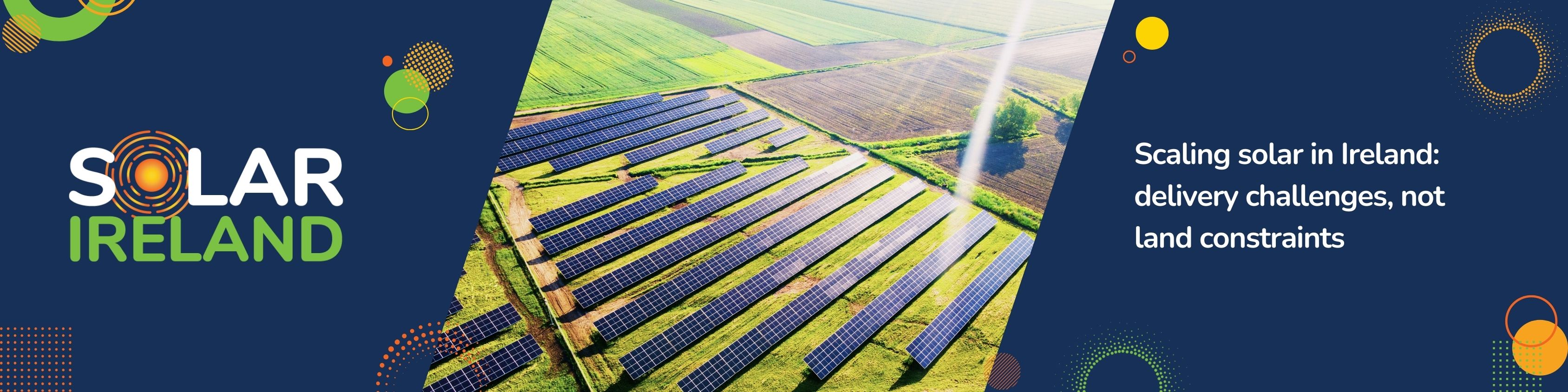
Within that small footprint, solar farms are designed to be low impact. Panels typically cover only about 40% of the site, with the remainder retained as grassland, hedgerows, and biodiversity buffers. Many sites support sheep grazing and pollinator habitats, allowing agricultural activity and ecological enhancement to coexist with energy generation.
For farmers, solar leasing provides predictable, long-term income that can be reinvested directly into the farm. This income is commonly used to fund slurry and nitrates compliance upgrades, energy-efficient equipment, new milking parlours, herd health improvements, debt reduction, and succession planning. In this way, solar is increasingly supporting farm resilience and ongoing investment, while maintaining agricultural use and delivering clean electricity.
Solar deployment in Cork, and across Ireland, is not constrained by land availability or farmer participation. The real task now is ensuring grid and planning systems move at the same pace as the delivery already taking place on the ground.