
Rooftop solar and energy security: why local generation matters for Ireland
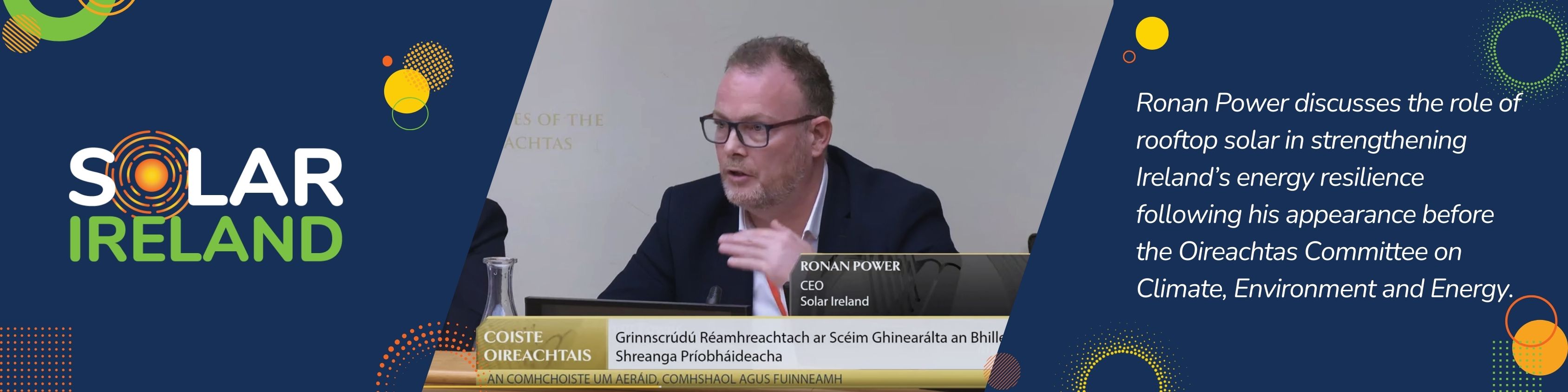
Earlier this week, Solar Ireland CEO Ronan Power appeared before the Oireachtas Joint Committee on Climate, Environment and Energy to discuss the proposed Private Wires framework and the role solar energy can play in Ireland’s evolving electricity system.
While the Committee discussion focused on regulation and infrastructure, the wider context for Ireland’s energy system is becoming increasingly clear. Global energy markets remain volatile, and geopolitical developments can quickly translate into rising oil and gas prices. For countries that rely heavily on imported fuels, those shocks are felt directly by households and businesses.
Ireland remains particularly exposed to this dynamic. The country continues to depend significantly on imported fossil fuels, meaning events far beyond its borders can influence domestic energy costs and supply risks. Strengthening Ireland’s energy resilience therefore requires expanding domestic sources of electricity wherever possible.
Ireland has made significant progress in renewable electricity over the past two decades, particularly through wind generation. Solar energy is now beginning to play an increasingly important role alongside it. As Ronan Power highlighted during the Committee discussion, solar deployment has expanded rapidly in recent years under existing grid and safety standards. The technology has become more accessible, and installations are now appearing on homes, farms and commercial buildings across the country.
Today, approximately half of the solar currently deployed in Ireland is rooftop generation. This distributed form of generation allows electricity to be produced close to where it is used, reducing reliance on imported fuels and contributing directly to national renewable electricity targets.
From an energy system perspective, this shift is significant. A network of thousands of smaller generation sources can complement large-scale infrastructure and diversify how electricity is produced across the country.
As Ronan Power told the Committee:
“Rooftop solar now represents a central component of Ireland’s delivery toward its 2030 renewable electricity targets. Under the definition of private wires as currently drafted, rooftop projects could require a full licence. Given the scale of deployment, that would place significant additional demand on the regulator and risks delaying thousands of households seeking to install solar each year.”
This highlights why the design of the regulatory framework will matter as the sector continues to grow.
Rooftop solar also gives households and businesses a direct role in the energy transition, allowing consumers to generate their own electricity while contributing to Ireland’s broader climate goals. For these reasons, rooftop solar is becoming an increasingly important component of Ireland’s pathway toward its 2030 renewable electricity targets.
As the sector continues to grow, policy and regulatory frameworks will need to evolve alongside it.
The Private Wires framework currently under consideration aims to modernise Ireland’s electricity system and create new pathways for renewable generators to supply energy users directly in certain circumstances. Private wires are not intended to replace the national grid, which will remain the backbone of Ireland’s electricity infrastructure. However, they can act as a complementary mechanism where grid connection timelines or costs might otherwise delay renewable projects.
As with any regulatory reform, the detail of implementation will matter. It will be important that the framework clearly distinguishes between large-scale electricity infrastructure and smaller on-site renewable installations such as rooftop solar. Around half of Ireland’s solar capacity now sits within the rooftop segment, which has scaled efficiently and safely under existing regulatory arrangements. Ensuring that regulation remains proportionate will help maintain this progress and support continued participation by households and businesses.
More broadly, the discussion reflects how renewable energy policy is increasingly linked to resilience as well as decarbonisation. Expanding domestic renewable generation reduces exposure to global fuel price volatility and strengthens Ireland’s ability to navigate an uncertain international energy landscape.
Every rooftop solar installation adds to Ireland’s local electricity supply. Over time, that growing network of distributed generation will play an increasingly important role in building a more secure, sustainable and locally powered energy system.