
Irish Women in Solar - Michelle Murphy, Collins Mc Nicholas
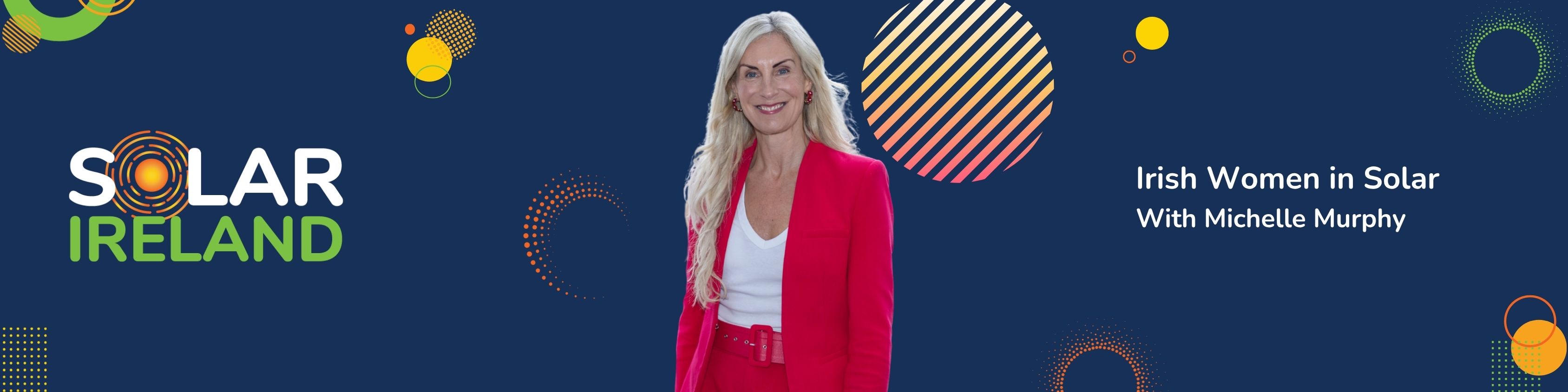
Ireland’s solar industry has scaled at remarkable speed. But delivering the next phase of growth will depend on more than projects, investment and infrastructure. It will depend on people.
That challenge is at the heart of The Experience Gap: Ireland’s Renewable Energy Workforce, Solar Ireland’s first dedicated report examining the people, skills and experience needed to support the continued growth of Ireland’s renewable energy sector. And there could hardly be a more timely moment to feature Michelle Murphy, Director at Collins McNicholas Recruitment & HR Services Group, in our Irish Women in Solar series.
Michelle and the Collins McNicholas team delivered the research behind The Experience Gap, helping to build an Irish evidence base around one of the defining challenges facing renewable energy: an industry growing faster than its experienced workforce.
Michelle has spent most of her career in recruitment and HR, working with organisations across medtech, pharma, manufacturing and professional services. Renewables increasingly came into focus through Collins McNicholas’ partnership with Solar Ireland, where the scale of the workforce challenge quickly became apparent.
As Michelle puts it:
“The panels, the planning and the finance all depend on someone being available to design, install, connect and maintain.”
It is a perspective that places people firmly alongside grid, planning and finance as a critical part of delivering Ireland’s energy transition.
From Recruitment to Workforce Strategy
Recruiters often see labour markets shift before those changes become apparent elsewhere. In solar, Michelle and her team were seeing demand for skills accelerate as the sector expanded. But the challenge is more nuanced than simply finding more people.
Through the research behind The Experience Gap, Michelle has helped examine where the workforce constraints really lie. One of the most important findings is that the sector is facing an experience gap, rather than simply a shortage of people.
“The sector is short of people who have done the job before, not short of people who could.”
That distinction matters.
Instead of competing harder for the same experienced candidates, Michelle believes employers need to think differently about how talent is developed, how transferable skills are recognised and how people from adjacent industries are supported into renewable energy roles. Her message to employers is clear:
“The talent pipeline is a build decision, not a purchasing decision.”
Construction, utilities, manufacturing and facilities all contain people with skills that can transfer into solar. Rather than waiting for the perfect CV to appear, Michelle argues that employers should invest in creating the bridge that allows those people to move across.
Moving from Anecdote to Evidence
For Michelle, The Experience Gap represents an important step in understanding Ireland’s renewable energy workforce.
The research combined a sector-wide survey, stakeholder interviews and market insights, giving the industry an Irish evidence base from which to better understand its workforce needs.
For her, its significance lies in moving the conversation “from anecdote to data”. It also demonstrates the wider role recruitment, and HR expertise can play in the energy transition. Beyond filling individual vacancies, Michelle sees an opportunity to help employers understand talent pools, benchmark the market, design roles people want to stay in and identify where targeted workforce development is needed.
Ultimately, recruitment and workforce strategy are not peripheral to deployment. They are part of what makes deployment possible.
Women, Visibility and Progression
Michelle works in a profession where women are well represented, but many of the sectors she supports, including energy, engineering and manufacturing, remain more male-dominated.
That has meant frequently being the only woman in a client meeting. Her experience has taught her the value of preparation, expertise and being able to support a position with evidence.
“Data has a way of levelling a room.”
But attracting more women into renewable energy will require action at several stages of a career. Michelle believes the sector needs to widen entry routes, including through apprenticeships, conversion programmes and recruitment from adjacent industries. She also argues that the conversation cannot stop at recruitment.
Retention matters too. Site-based roles, travel and inflexible working arrangements can make it harder to retain women at different stages of their careers. For Michelle, that is as much a question of job design as it is of the talent pipeline.
Visibility is equally important. Women need to see other women progressing into senior technical and commercial roles if they are to view renewable energy as somewhere they can build a long-term career.
It is one reason Michelle invests her own time in being part of the organising committee for initiatives such as the upcoming Network Ireland Galway’s Women Shaping the Future in STEM, which will provide an opportunity for Transition Year students to see the breadth of careers available.
The earlier someone can see a route into the sector, the easier it becomes to imagine themselves taking it.
There Is More Than One Route In
For women who may be interested in renewable energy but cannot see an obvious way in, Michelle’s advice is not to wait for a job title that perfectly matches their CV.
Solar needs project managers, commercial professionals, planners, HR specialists, finance teams, community engagement professionals, data specialists and lawyers alongside engineers and electricians.
“Pick the adjacent skill you already have, learn the sector's language, and go and talk to people who have experience across the sector.”
That message goes beyond gender.
As Ireland builds the workforce required for the next phase of renewable deployment, recognising transferable skills and creating pathways for people from other industries could significantly widen the available talent pool.
Looking Ahead: Building the Workforce as Deliberately as the Projects
Michelle sees enormous opportunity in the continued expansion of utility-scale, rooftop and commercial and industrial solar. But she believes Ireland has a choice about how much of the economic opportunity created by that growth remains here.
Building a domestic workforce and supply chain alongside deployment could make solar a career sector across the country, rather than simply an infrastructure programme. Achieving that will require greater coordination between industry, education providers and government, with a workforce plan that identifies the roles Ireland will need and creates practical pathways into them.
“We plan generation capacity in gigawatts; we should plan the workforce with the same discipline.”
Michelle would like to see workforce treated as critical infrastructure, considered alongside grid, planning and finance rather than assumed to follow automatically once projects are ready.
Over the next five years, she hopes the evidence base established through the partnership between Collins McNicholas and Solar Ireland can become a standing resource for the industry, while helping more women and career changers recognise opportunities they may not previously have considered.
Mentoring and professional networks are another important part of that picture. Michelle credits the different people and networks around her with providing support and guidance at important points throughout her career. It has shaped her own commitment to initiatives including Network Ireland, ElevateHR and the National Breast Cancer Research Institute.
“The value of someone being there to support you, listen and provide guidance is extremely powerful and hard to overstate.”
Ultimately, Michelle’s view of Ireland’s solar future comes back to the same principle that runs through both her work and The Experience Gap:
“Building the people as deliberately as we build the projects.”
Ireland can have the ambition, investment and renewable energy pipeline. But delivering it will require the people with the skills and experience to turn those plans into reality. Because the energy transition will ultimately move at the speed of the people available to deliver it.