
Irish Women in Solar - Klara Crowley
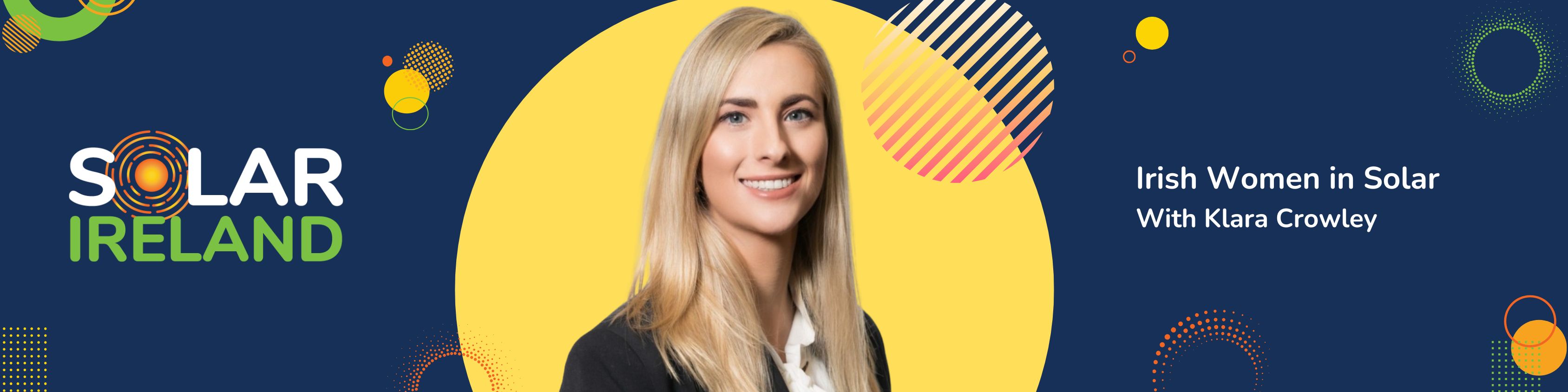
Ireland’s energy transition will be shaped not only by technology, but by the planning, policy and commercial decisions that enable projects to move from concept to delivery. Klara Crowley operates at that intersection.
A Chartered Town Planner with experience across Ireland and the UK, Klara has built her career across both the private and public sectors. Her background combines technical planning expertise with a deep understanding of infrastructure policy, regulatory frameworks and commercial strategy. Now, as Senior Planning Manager at Elgin Energy, she works across planning, development and commercial delivery of large-scale renewable energy projects.
From Strategy to Delivery
Klara’s move into solar was driven by a clear understanding of energy’s role in economic and national resilience.
“My interest in solar energy stems from its critical role in energy security, sustainable planning and long-term economic resilience.”
A turning point came during her MBA, where she worked on a renewable energy strategy to decarbonise a €3 billion company. That experience reinforced how closely energy decisions are tied to competitiveness, corporate responsibility and broader European energy security.
Solar, she believes, offers a rare alignment of commercial viability and environmental impact, making it a critical part of Ireland’s long-term energy strategy.
Delivering Complex Infrastructure
One of Klara’s proudest achievements has been leading Elgin’s first Irish and UK solar projects through financial investment decision, into construction and energisation.
“Seeing a project reach financial close and energisation is incredibly rewarding.”
Delivering utility-scale infrastructure requires far more than planning approval. It involves commercial structuring, financing alignment, stakeholder engagement and long-term risk management. For Klara, it is this complexity that defines the role and makes it meaningful.
Women in Solar
Working in a highly technical and commercially driven environment early in her career reinforced the importance of preparation, precision and consistent delivery. Over time, that foundation has shaped her leadership style. One that values resilience, collaboration and authenticity.
She believes increasing female representation is essential to delivering the energy transition successfully. Renewable projects sit at the intersection of planning, engineering, finance and community engagement. A broader mix of perspectives leads to stronger decision-making and more robust outcomes.
“Greater female representation in solar and renewable energy strengthens decision-making, enhances innovation and improves how we engage with communities and stakeholders.”
Her advice to women considering the sector reflects the pace and complexity of the industry.
“Stay curious and continuously build your skillset.”
Career paths are rarely linear, and skills from across planning, finance, law, engineering and policy are highly transferable. There is space for different leadership styles, and authentic leadership is a strength.
Looking Ahead
Klara sees significant opportunity for solar to play a greater role in Ireland’s energy mix, particularly through solar-plus-storage, co-location with wind and deeper decarbonisation of commercial and industrial demand.
“The scale of opportunity ahead is significant.”
Unlocking that potential will depend on continued collaboration across developers, policymakers, grid operators, local authorities and businesses, as well as the right planning frameworks and investment structures. She is particularly excited by the integration of solar with energy storage and smart grid technologies, alongside the growing role of digital optimisation tools in improving performance and system efficiency.
Looking ahead, her ambition is to contribute not only to project delivery, but to the broader direction of the sector.
“My ambition is to combine technical expertise, commercial insight and long-term strategic thinking to help accelerate the transition to a resilient, decarbonised energy system.”
Planning will shape what can be built. Strategy will shape how it is delivered. Klara’s work is a reminder that the energy transition is not only about generation capacity. It is about creating the frameworks that make that capacity possible.