
Can you trust what you see? How images can shape the energy debate
A picture may be worth a thousand words, but online it does not always tell the whole story.
Images and videos have become some of the most powerful ways we consume information. They are immediate, memorable and easily shared. In discussions about renewable energy, a single photograph of a solar farm, electricity infrastructure or a construction site can sometimes shape perceptions more quickly than pages of explanation or data.
But seeing something does not necessarily mean we are seeing the full picture. As part of Solar Ireland’s ongoing Media Literacy series, we are looking at another important skill for navigating today’s information environment: understanding how images can inform, influence and, sometimes, mislead.
“An image can look completely credible and still not be evidence that what it depicts is real.”
Priscila Mc Geehan, Director of Communications & Strategy, Solar Ireland
A real image can still create a misleading impression
Visual misinformation does not necessarily involve a fake or digitally manipulated photograph. A completely genuine image can become misleading when it is presented without the context needed to understand it.
A photograph taken during the construction of a solar farm, for example, may show exposed ground, machinery, temporary fencing and construction activity. If that photograph is later shared as an image of a completed development, the photograph itself remains authentic, but the impression it creates may be inaccurate.
The same applies to images that are old, taken in another country, tightly cropped or presented without information about when and where they were captured.
This distinction matters. When assessing visual information, the question should not simply be “Is this photograph real?” but also “Is it being presented in the right context?”
What is outside the frame?
Every photograph involves choices. Someone decides where to stand, what to include, what to exclude and when to take the picture. Cropping can remove surrounding context, while perspective can make infrastructure appear closer, larger or more dominant than it would from another viewpoint.
None of this automatically means an image has been deliberately designed to mislead. Photography has always involved framing. But it does mean we should be cautious about drawing broad conclusions from a single image.
If an image is being used to support a significant claim, ask whether another angle, a wider view or additional information would change your understanding of what you are seeing.
Images have sources too
We have become accustomed to asking where statistics and quotations come from. We should develop the same habit with images and videos.
Before accepting or sharing an image, consider:
- Who originally published it?
- Where and when was it taken?
- Is the location identified?
- Is it a current photograph?
- Is it showing construction, operation or another stage entirely?
- Does the caption accurately describe what the image shows?
- Can the original version or source be found?
Reverse-image searching can also help identify whether an image has appeared previously in a different context.
These simple checks can be particularly useful when photographs are reshared across social media or messaging platforms without their original caption, date or source.
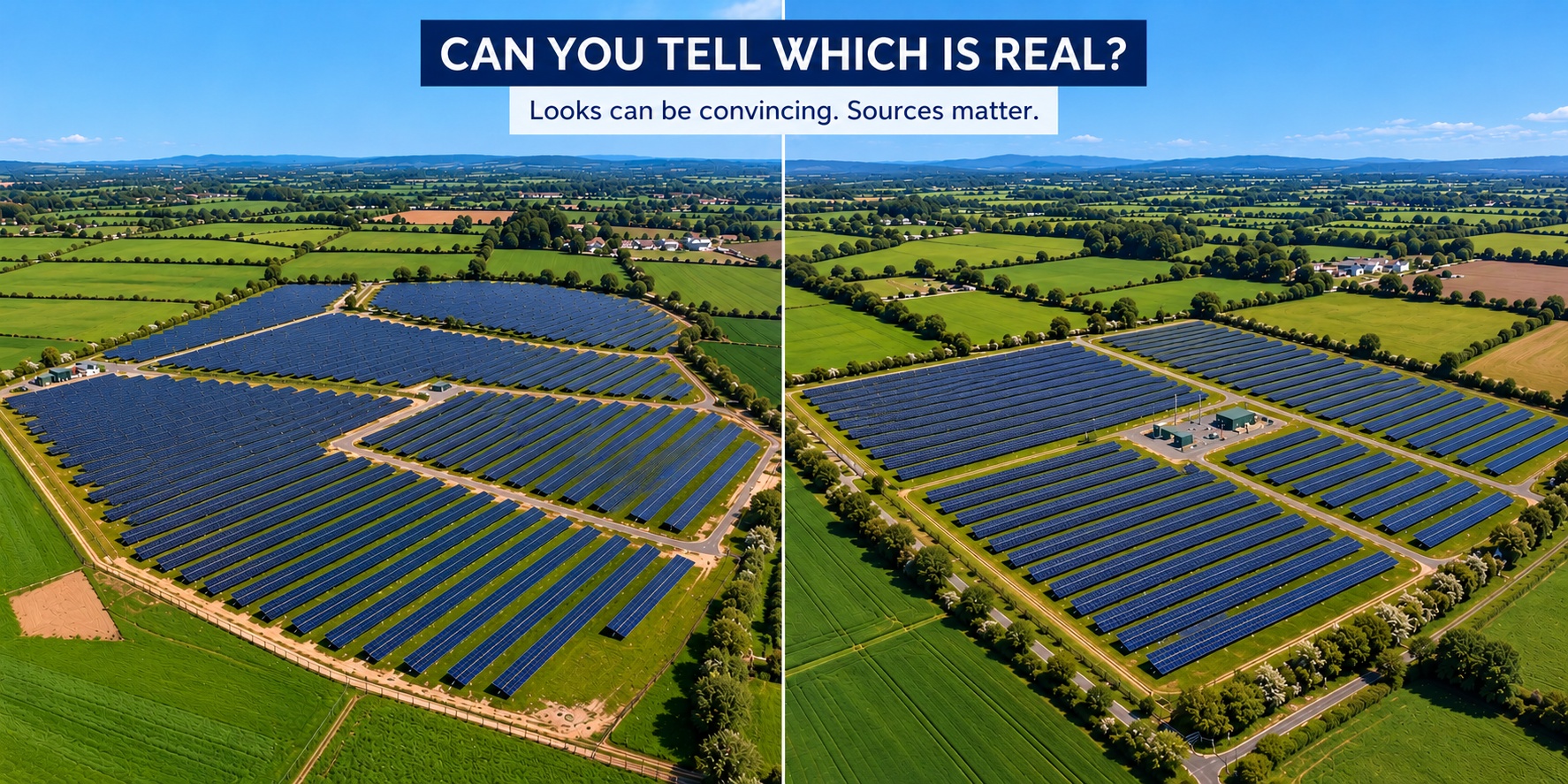
Can you tell which is real?
The image accompanying this article presents a simple challenge: two images of solar farms, one a real photograph and the other created using generative AI.
Can you tell which is real?
Maybe... but that is not really the point.
Both can look convincing. And as AI technology improves, identifying synthetic imagery simply by looking for visual mistakes is becoming increasingly difficult.
The more important question is: how would you verify it?
One image has a provenance. It is a photograph of a real solar farm, captured by a camera at an identifiable place and time. The other depicts a scene that looks entirely plausible but was generated artificially. That distinction illustrates an increasingly important principle of media literacy: appearance alone is not proof of authenticity.
The rise of AI-generated content
Generative artificial intelligence can now produce highly realistic images in seconds. As the technology develops, determining simply by looking at an image whether the scene depicted ever existed is becoming more challenging. An image can look completely credible and still not be evidence that what it depicts is real.
AI-generated imagery has many legitimate creative and professional applications. The media literacy challenge arises when synthetic content is presented, intentionally or otherwise, as documentary evidence of a real event, place or development.
Traditional clues such as distorted details, unusual text, inconsistent shadows or physical impossibilities may sometimes reveal AI-generated imagery. But relying on those clues alone is becoming less effective as the technology improves. That makes source verification increasingly important. Rather than asking only “Does this look real?”, we increasingly need to ask “Where did this come from, and can I verify it?”
Emotion deserves a second look
Images are particularly effective at generating emotional responses. A dramatic photograph can make us angry, concerned or surprised before we have had time to consider its source or context. That response is human, but it can also make us more likely to react or share quickly.
If an image produces a particularly strong reaction, that can be a signal to pause. Look at the caption. Find the original source. Check whether credible sources are reporting or publishing the same information. Consider what might be outside the frame and whether the image is actually evidence for the claim being made alongside it.
The objective is not to distrust every photograph or video we encounter. It is to recognise that visual content deserves the same critical assessment we apply to written claims.
Seeing the bigger picture
Ireland’s energy transition is becoming an increasingly prominent part of public discussion.
As solar, battery storage and electricity infrastructure develop across the country, people are encountering more information, images and commentary about the energy system and how it is changing. It is entirely legitimate for people to ask questions about new infrastructure, how projects are developed and what they mean for communities.
Those conversations are better when they are based on accurate information and a fair representation of what is actually happening. Media literacy does not ask us to dismiss images that challenge our existing views. Nor does it ask us to accept images that reinforce them. It asks us to look beyond the first impression.
Before allowing one photograph, video or graphic to shape our understanding of an issue, it is worth asking a few simple questions:
- Where did it come from?
- What does it actually show?
- What might be outside the frame?
- And do I have enough context to understand it?
In an information environment that is becoming increasingly visual, learning to question what we see may be just as important as learning to question what we read.
About the image: One of the solar farm images accompanying this article is a genuine photograph; the other was created using generative AI specifically for this Media Literacy article. The comparison demonstrates why visual appearance alone is no longer sufficient to establish authenticity. Left: Bullstown Solar Farm, photographed in Ireland. Right: an entirely AI-generated image. No such photograph or solar farm exists.
Media Literacy Series
This article is part of Solar Ireland’s Media Literacy series, helping people navigate information about renewable energy and the energy transition with confidence. The series explores misinformation, source credibility, critical thinking and the practical skills that support informed public discussion.