
From 3 GW to the next phase: Ireland must unlock the full value of solar
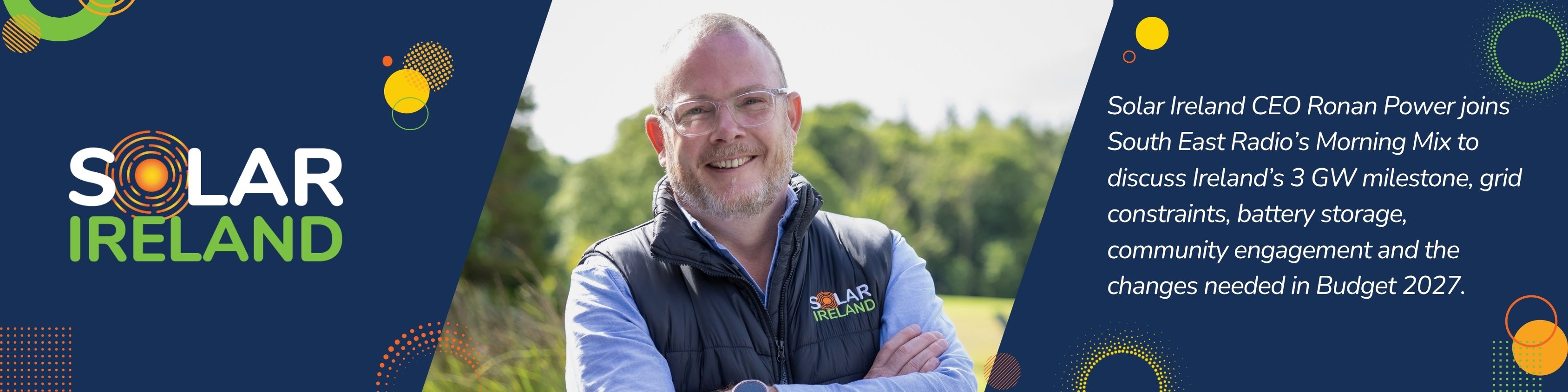
Speaking on South East Radio’s Morning Mix, Solar Ireland CEO Ronan Power discussed Ireland’s 3 GW solar milestone, the urgent need for grid investment and storage, the importance of community engagement, and the measures needed in Budget 2027 to support the sector’s next phase of growth.
Ireland’s solar sector has moved from a standing start to a central role in the electricity system in just a few years. During periods this summer, solar supplied more than one-third of Ireland’s electricity demand, while the country recently passed 3 GW of installed solar capacity.
For Ronan Power, CEO of Solar Ireland, that progress shows that solar is no longer an emerging technology in Ireland.
“We’re becoming a meaningful part of the mix.”
Speaking to Alan Corcoran on South East Radio’s Morning Mix, Ronan said the challenge now is to ensure Ireland’s electricity infrastructure and energy policy can keep pace with the rate at which renewable generation is being delivered.
Turning solar success into system value
Ireland’s electricity grid was designed around a relatively small number of large, centralised power stations. Solar is different. It is distributed across the country, from panels on homes and businesses to larger solar farms, and it generates most strongly during daylight hours.
That shift requires a more flexible electricity system. At present, renewable generators are being turned down when the grid cannot accommodate all the clean electricity available. Ronan pointed to an estimated 14% of potential renewable generation currently being lost through these constraints.
Ronan said Ireland now needs to upgrade its infrastructure at pace so that more of the renewable electricity being generated can be used.
The Commission for Regulation of Utilities has approved €18.9 billion in investment in Ireland’s electricity networks under PR6. Ronan stressed that this investment is welcome, but must be supported by a clear delivery plan, measurable targets and accountability.
“Without a target, nothing is ever going to be measured.”
The task is not simply to catch up with today’s needs. Electricity demand is expected to continue growing as homes, transport, heating and industry electrify, so the grid must also be ready for the system Ireland will need in the years ahead.
Solar and storage must go hand in hand
Battery storage was a central part of the discussion. Allowing solar farms and batteries to share the same grid connection would enable clean electricity that cannot be exported immediately to be stored and used later, including after the sun has gone down.
Ronan called for a clear hybrid connections policy to make better use of existing solar assets and grid infrastructure.
Ronan said solar and battery storage “go hand in hand”.
This would help Ireland capture more of the renewable energy it already has the capacity to produce, reduce waste and deliver more value from existing grid connections.
Reducing exposure to global energy shocks
The conversation also turned to household energy costs. Ireland remains exposed to international gas prices, which continue to have a major influence on wholesale electricity prices. Increasing the amount of electricity generated from domestic renewable sources can help reduce that exposure over time.
For individual households, rooftop solar offers a more immediate benefit by reducing the amount of electricity they need to buy from the grid. During the brighter months, households can also receive credits for surplus electricity exported to the system and use those credits against winter bills.
“Solar can actually help insulate people from some of those global events.”
Communities must be part of the story
The interview also explored concerns about solar farm development and agricultural land in County Wexford.
Ronan acknowledged that community concerns must be heard and said the industry would welcome greater discussion and clearer planning guidance. Early and meaningful consultation can give communities a stronger voice in how projects are developed, while providing greater consistency for local authorities, developers and landowners.
Ronan said communities should be part of the story and involved in consultation about what local development looks like.
Solar farms can also provide farmers with a stable, long-term income stream, often helping to support the wider farm business. Projects developed through government renewable energy schemes provide Community Benefit Funds that can support local initiatives and facilities.
Wexford already has a significant place in Ireland’s solar story, from strong household adoption and utility-scale projects to Rosslare Europort’s growing role in the renewable energy supply chain.
Building Irish capability through Budget 2027
Looking ahead to Budget 2027, Ronan highlighted the need to remove barriers that can slow renewable energy delivery and make it more difficult for Irish businesses to grow.
One example is Relevant Contracts Tax. Solar projects often require specialist contractors, and withholding rates can place considerable pressure on the cash flow of newer or growing companies. Reforming the system for compliant specialist contractors could help more Irish firms enter the market, build expertise and create skilled local jobs.
Together with stronger resourcing for the CRU, faster grid delivery and a workable framework for hybrid solar and storage projects, this would help Ireland turn rapid solar growth into lasting economic and energy-system value.
Solar has already shown what it can deliver. The priority now is to build the grid, policy and regulatory framework that will allow Ireland to use every possible unit of clean, home-grown electricity.
Listen to Ronan Power’s full interview on South East Radio’s Morning Mix